
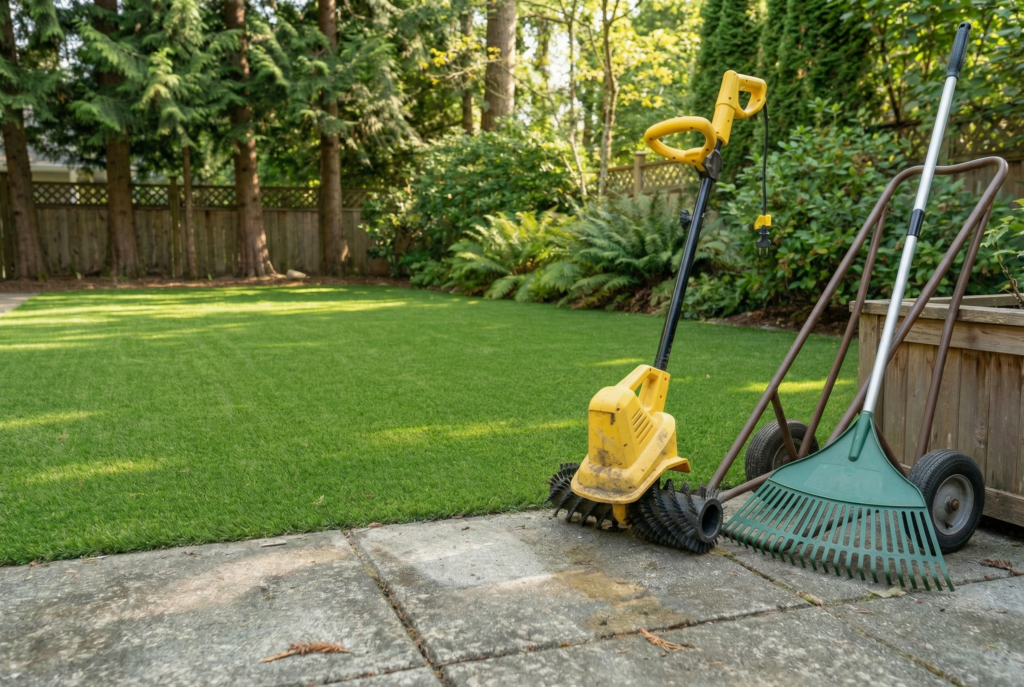
Artificial turf is engineered to deliver long-term performance with minimal upkeep. However, minimal maintenance does not mean no maintenance. When turf begins to appear flat, dull, or worn, it is often incorrectly assumed to be a product defect. In reality, these changes are the natural result of environmental exposure, traffic patterns, and maintenance habits.
Understanding how to properly care for artificial turf is essential. When maintained correctly, it can retain its original appearance and functionality for many years.
Why Artificial Turf Loses Its “New” Appearance
Artificial turf is continuously exposed to external conditions that influence its appearance over time. These include foot traffic, UV exposure, dust accumulation, organic debris, and pet use. Each of these factors contributes to gradual visual changes such as fiber flattening, reduced vibrancy, or localized wear.
These outcomes are expected and do not indicate a failure of the product. Instead, they reflect how the turf is being used and maintained within its environment.
According to the , routine grooming and cleaning are necessary to preserve both the aesthetic and functional performance of artificial turf systems.
Core Maintenance Practices That Preserve Turf Condition
Regular Brushing to Maintain Fiber Structure
Over time, foot traffic causes turf fibers to lean and compress. Without intervention, this leads to a matted appearance.
Brushing restores the vertical position of the fibers and redistributes infill evenly. This process reduces premature wear and helps maintain a natural look. A stiff-bristled broom or mechanical brush should be used, working against the grain. High-traffic areas require more frequent attention due to repeated impact.
Consistent Debris Removal to Prevent Surface Degradation
Organic debris such as leaves, dust, and soil can accumulate within the turf system. This buildup not only affects appearance but also traps moisture, contributing to hygiene issues.
Routine removal supports proper drainage and reduces the risk of odor or bacterial growth. Tools such as leaf blowers or non-metal rakes are typically sufficient for this purpose.
The notes that unmanaged organic matter can accelerate surface deterioration and negatively impact sanitation.
Periodic Rinsing to Restore Surface Cleanliness
Fine dust and airborne particles gradually settle into the turf, reducing its visual clarity. Occasional rinsing helps remove these contaminants and restore color vibrancy.
This is particularly important in dry or high-dust environments and in areas exposed to pets. Rinsing also supports overall hygiene and reduces surface residue.
Infill Management as a Structural Requirement
Infill plays a critical role in supporting turf performance. It stabilizes the fibers, reduces friction, and contributes to temperature regulation.
When infill levels drop or become uneven, the turf can appear prematurely worn. Maintaining proper infill distribution ensures that fibers remain upright and protected from excessive stress.
They emphasize that infill conditions directly impact long-term durability and visual performance.
Managing High-Traffic Areas Before Wear Develops
Certain zones experience concentrated use, including entry points, pathways, and pet areas. These locations are more susceptible to visible wear patterns if not properly managed.
Early intervention is essential. Introducing stepping stones or designated walkways can significantly reduce concentrated stress. Additionally, increasing maintenance frequency in these areas helps preserve uniformity across the surface.
This type of wear is predictable and usage-driven, not a defect in the turf.
Controlling Heat and Environmental Stress
In high-temperature conditions, artificial turf can expand and become more susceptible to stress under repeated use. Walking across overheated turf, especially along consistent paths, can accelerate fiber fatigue.
Mitigation strategies include light surface cooling with water, selecting appropriate infill materials such as zeolite, and designing shaded or alternative pathways. These measures reduce stress on the turf during peak heat conditions.
Field-Based Insight from Long-Term Use
Across years of real-world installations, a consistent trend is evident. Turf systems that receive routine maintenance retain their structure, color, and performance significantly longer than those that are neglected.
Where maintenance is limited, common outcomes include fiber matting, uneven appearance, and localized wear. In contrast, well-maintained turf continues to perform as intended, even under regular use.
The determining factor is not the product itself, but how it is managed over time.
Protecting Turf for Long-Term Performance
Maintaining a like-new appearance requires a consistent and proactive approach. The most effective strategy includes:
- Routine brushing to prevent fiber matting
• Ongoing debris removal to protect drainage and cleanliness
• Periodic rinsing to eliminate dust and contaminants
• Monitoring and maintaining infill levels
• Managing traffic flow and environmental exposure
Artificial turf functions as a complete system. When each component is properly maintained, both appearance and durability are preserved.
Final Takeaway
Changes in artificial turf appearance are almost always the result of environmental conditions and usage patterns, not manufacturing defects. These outcomes are predictable and manageable.
With proper maintenance practices in place, artificial turf can maintain its original look and performance for years. The responsibility lies not in the product, but in how it is cared for within its environment.