
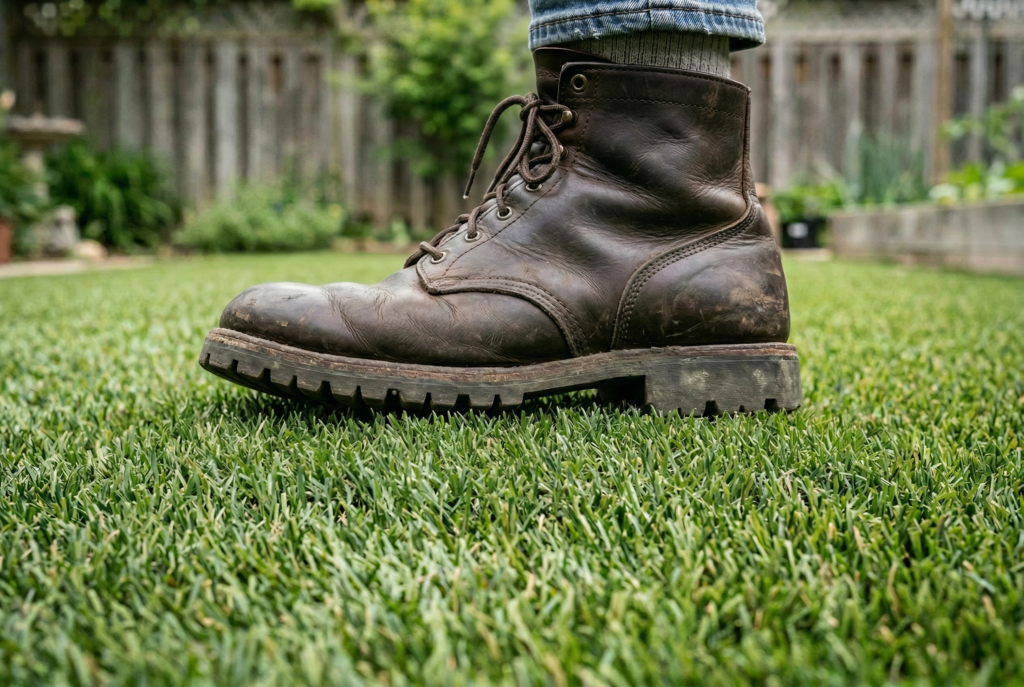
Artificial turf is engineered to withstand consistent use, but it is not indestructible. One of the most common and misunderstood issues homeowners face is premature wear in specific pathways across their lawn. These worn areas are often mistaken for product defects when, in reality, they result from concentrated foot traffic without proper walkway planning. This case study explains why this occurs, what causes the damage, and how it can be prevented through proper design and usage.
The Real-World Scenario
A residential backyard installation began showing visible wear within months of completion. The turf fibers along a direct line from the patio door to the side gate had flattened, thinned, and in some areas, broken down completely.
The remainder of the lawn remained in excellent condition.
The initial assumption was that the turf product had failed. However, upon inspection, the issue was clearly localized and directly tied to repeated, concentrated foot traffic.
What Causes This Type of Wear
Artificial turf fibers are designed to recover from normal use. However, when traffic becomes repetitive and concentrated in a single path, the system begins to break down.
Key contributing factors include:
- Repetitive directional traffic
Walking the same path daily creates consistent pressure on the same fibers, preventing recovery and accelerating fatigue. - Lack of load distribution
Without a designed walkway, all foot traffic is forced into narrow zones rather than being spread across the surface. - Infill displacement
Heavy traffic gradually pushes infill away from high-use areas, reducing support for the turf blades and increasing stress on the fibers. - Heat-related softening
In warm climates, turf fibers become more flexible. Repeated traffic in this state increases the likelihood of permanent deformation and breakage.
According to the Synthetic Turf Council, proper design, including traffic management, is essential to maintaining the long-term performance of artificial turf systems.
Why This Is Not a Turf Defect
This type of wear is a predictable and well-documented behavior of synthetic turf under concentrated use.
Artificial turf is designed for distributed traffic, not repeated impact in a single line. When used outside of these conditions, the fibers will wear faster in those specific areas.
Research from Penn State Extension indicates that surface wear in turf systems is primarily influenced by usage patterns rather than by material failure.
In this case, the turf performed exactly as expected given its use.
The Underlying Design Oversight
The core issue in this case was not installation quality or product selection. It was a lack of pathway planning.
Any space with predictable movement patterns should account for:
- Entry and exit points
• Natural walking lines (desire paths)
• High-frequency use zones
Without these considerations, turf is unintentionally exposed to concentrated stress.
This concept is widely recognized in landscape architecture as “desire path formation,” in which users naturally create their own routes regardless of the intended design.
How to Prevent High-Traffic Wear
The solution is not a stronger turf. The solution is a smarter design.
Effective prevention strategies include:
- Install hardscape walkways
Pavers, stepping stones, or concrete paths absorb impact and protect turf in high-use routes. - Distribute traffic intentionally
Design layouts that encourage movement across multiple areas rather than along a single line. - Use higher-density turf in transition zones
Select products designed for heavy traffic near entrances and access points. - Maintain proper infill levels
Regular brushing and infill top-ups help support fibers and reduce stress in active areas. - Plan for behavior, not just aesthetics
Design should reflect how the space will actually be used, not just how it looks on day one.
Case Study Conclusion
This case clearly demonstrates that premature wear in artificial turf is often the result of usage patterns and design limitations, not product failure.
When traffic is concentrated and unmanaged, even high-quality turf will show signs of wear over time. By incorporating walkway planning and understanding how people naturally move through a space, homeowners can significantly extend the lifespan and appearance of their turf.
Final Takeaway
Artificial turf performs exceptionally well when installed and used within its intended design conditions.
If you see wear developing in a straight line or along a specific path, it is not random and not a defect. It is a signal that the space needs better traffic management.
Proper planning prevents problems.