
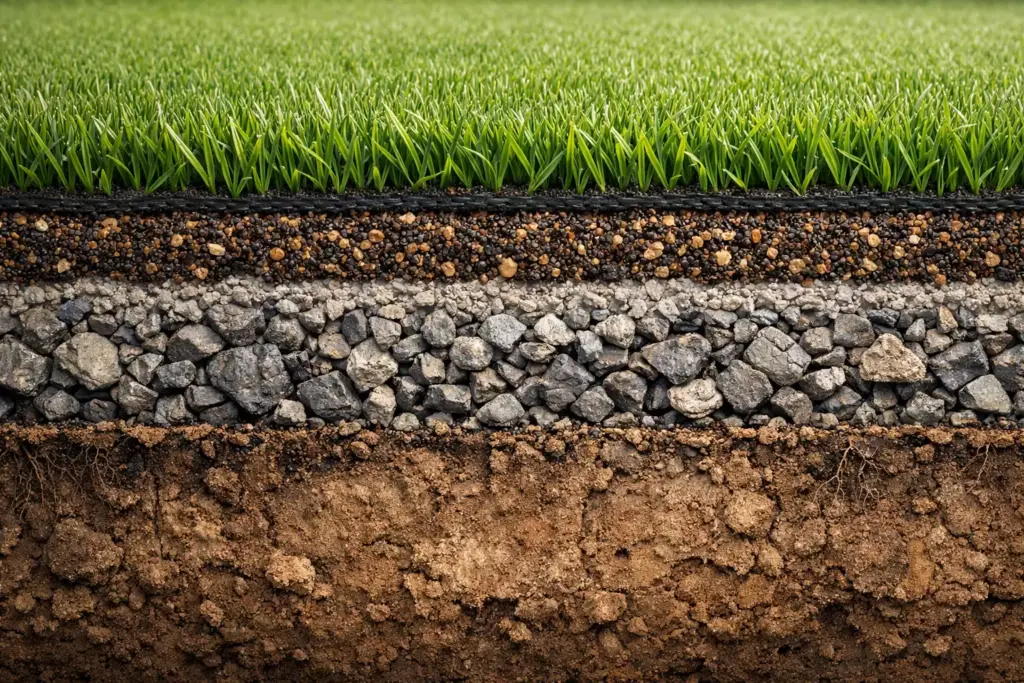
When artificial turf installations develop pooling water, odors, or surface instability, the turf itself is often blamed. In reality, these issues are most commonly the result of inadequate drainage design beneath the surface. Artificial turf is a permeable system, but only when it is supported by a properly constructed drainage foundation. Without this support, even the highest-quality turf will underperform.
This article explains why drainage is a critical component of every installation, what causes failures, and how to prevent these issues through proper planning and construction.
Why Drainage Is Foundational to Turf Performance
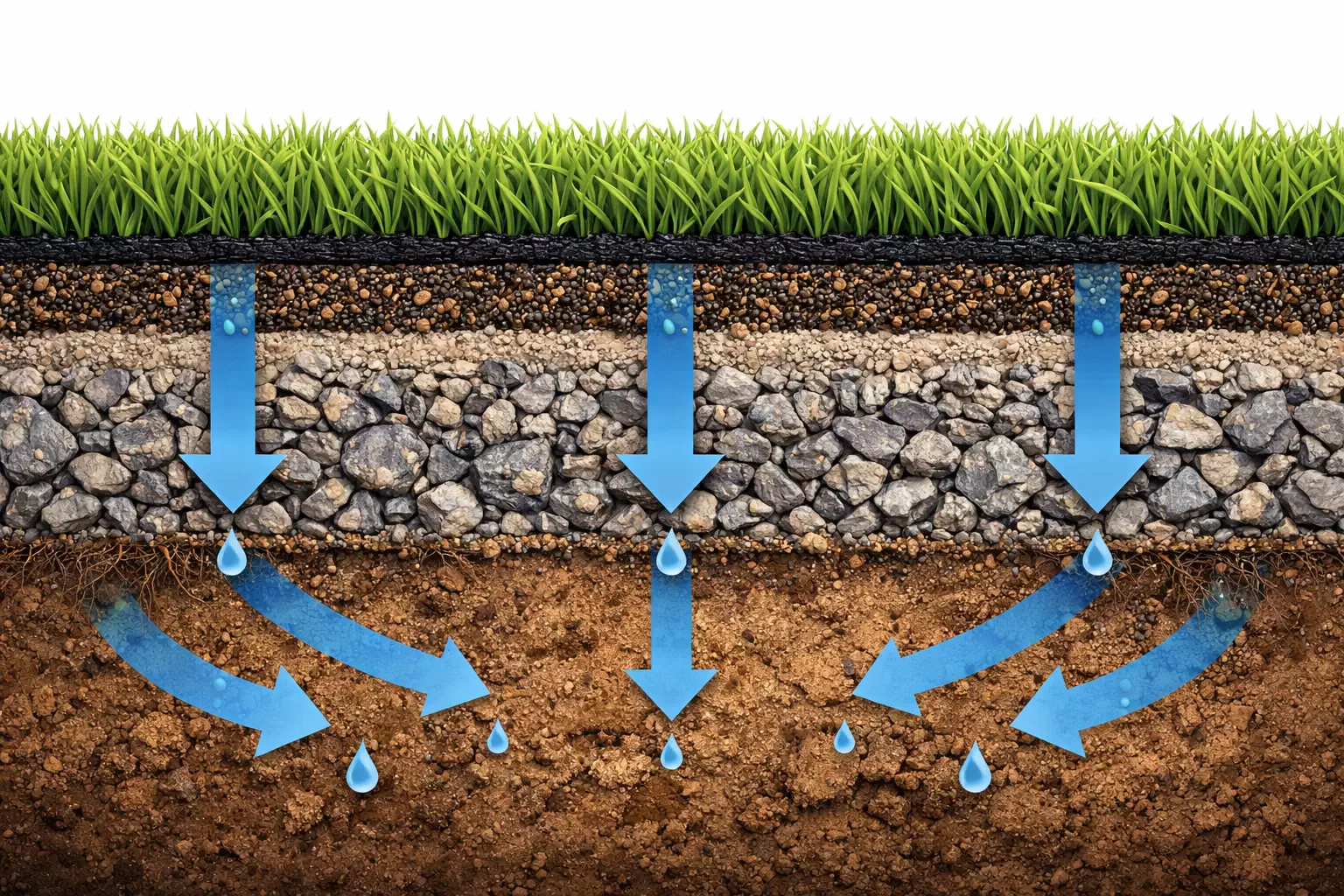
Artificial turf is engineered to allow water to pass through its backing. However, effective performance depends on the entire system managing that water correctly.
- Water must move vertically through the turf
- It must disperse evenly into the base layer
- It must exit efficiently through the sub-base and underlying soil
If any part of this process is compromised, water will accumulate. The turf is not failing; it is reflecting the condition of the drainage system below.
Common Drainage Failures and Their Causes
Drainage issues are predictable and typically stem from a limited number of design or installation errors.
Inadequate base material
When incorrect aggregates or insufficient base depth are used, water cannot move freely through the system. Fine materials or overly compacted layers may trap water rather than allow drainage.
Lack of proper grading
Even a minimal slope, typically 1 to 2 percent, is required to direct water away from the surface. Flat installations frequently result in standing water and localized saturation.
Low-permeability subsoil
Native soils with high clay content restrict water absorption. Without additional drainage measures, water becomes trapped within the system.
Missing drainage infrastructure
In areas exposed to heavy rainfall or concentrated water flow, supplemental systems such as French drains, perforated piping, or drainage layers are often necessary. Without these elements, the system can become overwhelmed.
How Drainage Problems Appear at the Surface
Drainage failures rarely remain hidden. They are clearly visible on the turf surface and are often mistaken for product-related issues.
- Persistent puddling after rainfall or irrigation
- Soft or unstable areas underfoot
- Odor buildup, particularly in pet applications
- Infill movement or displacement
- Accelerated or uneven wear patterns
Real-World Installation Insight
Field experience consistently shows that drainage issues are often influenced by the surrounding environment, not just the turf system itself. A common scenario occurs when the base is installed correctly, but the surrounding landscape directs water into the turf area.
For example, when turf is installed at a lower elevation than adjacent patios, driveways, or lawns, runoff naturally collects in that space. The turf effectively becomes the lowest point in the landscape and functions as a drainage basin. The result is water accumulation, saturation, and concern from homeowners, even though the turf product is performing as designed.
How to Prevent Drainage-Related Problems
Effective drainage begins at the design stage and must be carried through installation with precision.
Design considerations
Site conditions should be carefully evaluated, including soil composition, permeability, and natural water flow. Grading and slope must be planned intentionally to direct water away from the installation area.
Installation practices
A properly selected and installed aggregate base, typically composed of crushed stone, is essential. The base must be installed at the correct depth and compacted to the appropriate degree to maintain both stability and permeability.
Additional protective measures
In higher-risk areas, supplemental drainage solutions may be required. These may include subsurface drainage systems, edge controls to manage runoff, and design adjustments that prevent the creation of low points where water can accumulate.
Final Takeaway
Artificial turf does not create drainage problems; it reveals them. When water is not properly managed within the system, the surface will display clear and consistent warning signs. These should not be interpreted as product defects, but rather as indicators of underlying design or installation deficiencies.
With proper planning, grading, and base construction, artificial turf remains one of the most efficient and reliable permeable surface solutions available. Without these elements, even the best turf systems cannot perform as intended.
Understanding this distinction is essential for protecting your investment and ensuring long-term success in any turf installation.