
When artificial turf begins to look or feel irregular, it is often assumed that the product itself is failing. In practice, most issues originate beneath the surface. A compromised base will reveal itself through visible and physical changes in the turf over time. Identifying these warning signs early is critical, as minor issues can quickly develop into costly repairs if left unaddressed.
This guide explains how to recognize base failure, what causes it, and how to prevent further deterioration.
Why Base Failure Appears Through the Turf
Artificial turf is a surface system that conforms to the conditions beneath it. Any instability in the foundation will be reflected at the surface level.
- If the base shifts, the turf will shift
- If the base settles, the turf will sink
- If drainage is compromised, water will remain in place
The turf is not malfunctioning. It accurately reflects the performance of the underlying base.
Early Warning Signs of a Failing Turf Base
Base failure follows predictable patterns. The following indicators are among the most common and should not be overlooked.
Uneven areas or soft spots
One of the earliest signs is a noticeable change in how the surface feels underfoot. Areas may feel spongy, unstable, or compress more than surrounding sections. Minor dips may begin to form in areas that were previously level. This typically indicates insufficient compaction or early-stage base movement caused by unstable subgrade conditions.
Low areas and visible depressions
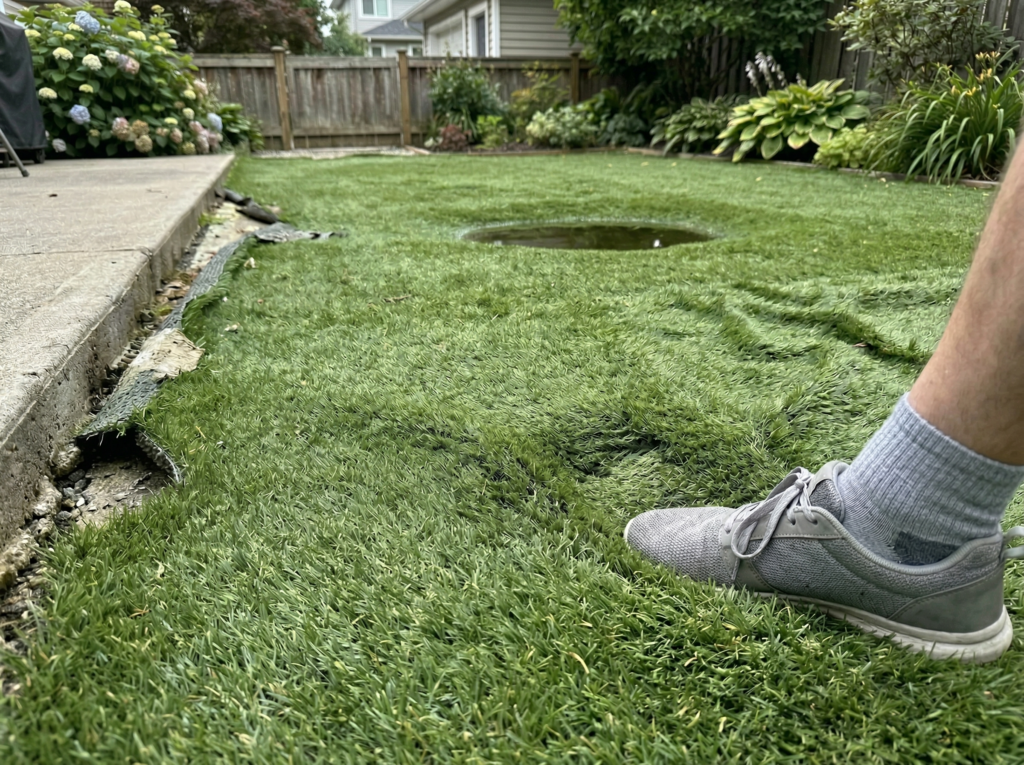
Over time, small inconsistencies can develop into more defined depressions. These areas often collect water and appear sunken relative to the surrounding surface. This condition is usually the result of base settlement due to inadequate compaction or insufficient base depth.
Water pooling after rain or irrigation
Artificial turf systems are designed to drain efficiently. Standing water is not a normal condition. Persistent puddling or slow drainage in specific areas indicates a failure in the drainage layer. This may result from improper base material, compacted or blocked drainage pathways, or incorrect grading.
Wrinkling or rippling of the surface
A properly installed turf system should remain smooth and tensioned. The appearance of ripples or wrinkles suggests movement beneath the surface. This is commonly associated with base instability or edge anchoring issues, both of which are directly tied to inadequate groundwork.
Edge lifting or separation
The perimeter of a turf installation is particularly sensitive to base performance. Edges pulling away from hardscape, gaps forming along borders, or lifting at seams are clear indicators of base erosion or movement, often caused by poor compaction or water displacement.
Accelerated wear in high-traffic areas
Excessive wear in specific pathways or zones is often misinterpreted as a turf quality issue. In reality, an unstable base allows increased movement underfoot, creating friction at the backing level. This leads to premature fiber breakdown and uneven wear patterns.
What Causes Turf Base Failure
Base failure is rarely random. It is typically the result of identifiable installation or environmental factors:
- Improper compaction, particularly when materials are not installed in controlled layers
- Incorrect base material that does not compact or drain effectively
- Insufficient excavation depth, limiting structural support
- Poor drainage design, allowing water to weaken and shift the base
- Delayed or missing infill, which reduces system stability and increases stress transfer
Real-World Insight from Field Experience
Across years of field inspections, a consistent pattern emerges. Homeowners frequently report what they believe to be turf failure. Surface-level symptoms are visible, but closer evaluation almost always reveals deficiencies within the base system.
In most cases, the turf remains structurally intact. The underlying issues are typically linked to settlement due to poor compaction, water-related damage from inadequate drainage, or movement caused by weak base construction.
How to Prevent the Problem from Getting Worse
Early intervention is essential in limiting long-term damage. Small issues can often be corrected if addressed promptly.
- Address minor depressions or soft areas before they expand
- Reduce traffic in the affected zones to prevent further movement
- Observe drainage behavior after rainfall to identify problem areas
- Seek evaluation from an experienced installer to determine the extent of the issue
When Repairs Are Still Possible
In the early stages, base-related issues can often be corrected without full system replacement. Typical corrective measures include lifting and re-compacting localized sections, adjusting or adding base material, and improving drainage in affected areas.
If these warning signs are ignored, the problem can progress, ultimately requiring the system to be fully removed and reinstalled.
Conclusion
A failing turf base develops gradually and presents clear, identifiable warning signs. Recognizing these indicators early allows homeowners to take corrective action before minor concerns escalate into major structural failures.
Most importantly, it reinforces a critical understanding: these issues do not originate from the turf itself. They are the result of foundation instability.