
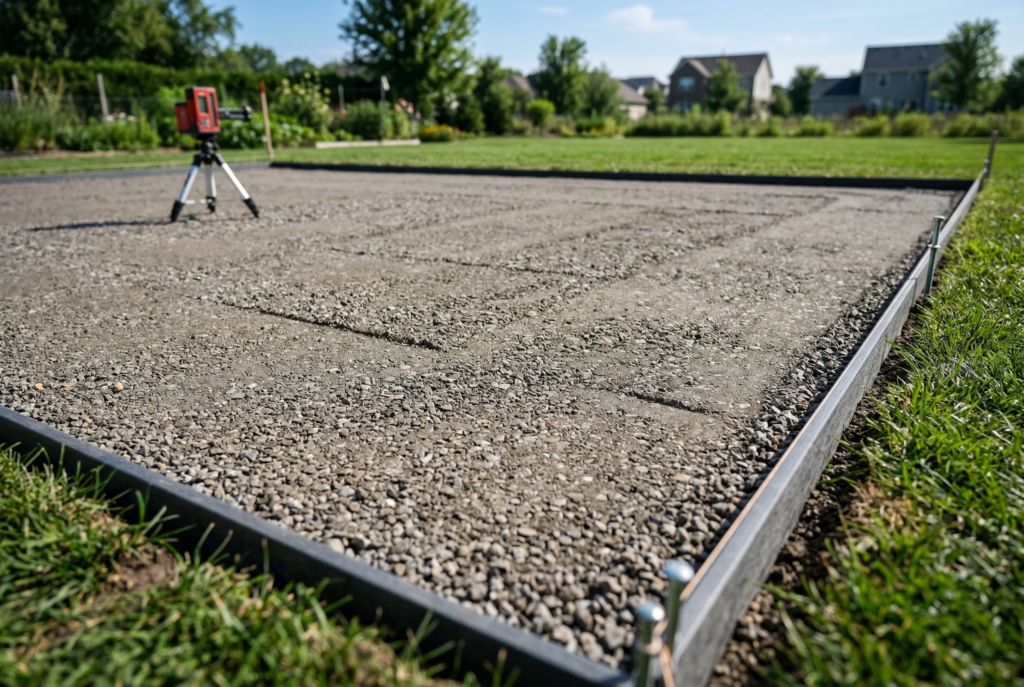
When artificial turf systems fail, whether through uneven surfaces, poor drainage, or premature wear, the root cause is rarely the turf itself. In most cases, failure can be traced back to improper base preparation. A well-constructed base serves as the structural foundation of any successful turf installation; without it, even the highest-quality turf will underperform. This article outlines why base preparation is critical, what occurs when it is executed incorrectly, and how to ensure long-term system performance.
The Role of the Base in Artificial Turf Systems
The base layer beneath artificial turf performs three essential functions that directly influence performance and longevity:
- Structural stability, which prevents shifting, sinking, and surface irregularities
- Drainage management, allowing water to move efficiently through the system
- Load distribution, supporting foot traffic and reducing localized wear
Industry standards consistently reinforce that long-term success is determined by the base system rather than the turf fibers themselves.
What Happens When Base Preparation Is Done Incorrectly
Improper base work leads to predictable, repeatable failures. These issues are not random; they are the direct result of inadequate groundwork.
Uneven surfaces and low areas
If grading and compaction are not properly completed, the turf will reflect every imperfection beneath it. Over time, this results in visible dips, wrinkling, and unstable footing.
Poor drainage and water retention
Without a properly designed aggregate base, water cannot move freely. This often leads to standing water, migration of fine materials beneath the turf, and odor issues in pet environments.
Base movement and settlement
When subgrade soils are not properly stabilized or compacted, the base will shift over time. This commonly results in seam separation, edge lifting, and potential trip hazards.
Premature turf wear
An unstable base allows movement underfoot, creating friction at the backing layer. This accelerates fiber breakdown. What may appear to be a turf defect is typically mechanical stress originating from below.
Why This Is Not a Turf Defect
Artificial turf is a surface system designed to perform under stable, engineered conditions. When those conditions are compromised, the turf reflects the failure rather than causes it.
From a materials standpoint:
- Turf fibers do not manage drainage
- Turf backing does not correct grading deficiencies
- Turf systems cannot compensate for soil movement
Understanding this distinction is essential. Most visible surface issues are system failures, not product defects.
Best Practices for Proper Base Preparation
A reliable installation begins well before the turf is laid. The following practices are fundamental to long-term performance:
Subgrade evaluation
The native soil must be assessed for compaction potential, organic content, and drainage characteristics. In weaker soils, stabilization or removal may be required.
Correct aggregate selection
A properly graded crushed aggregate base, commonly ¾ inch minus, is critical. This material compacts effectively while maintaining permeability and structural integrity.
Layered compaction
Base materials should be installed in controlled lifts, typically 2 to 3 inches at a time, and mechanically compacted. Skipping this step leads to future settlement.
Proper grading and slope
A consistent slope of approximately 1 to 2 percent ensures water moves away from structures and prevents pooling.
Timely infill installation
Infill should be applied immediately after turf installation. This stabilizes the fibers, adds weight to the system, and is especially important in high-heat or high-traffic environments.
Real-World Observation (15 Years of Field Experience)
Across hundreds of installations, a consistent pattern is evident. Projects with properly constructed bases rarely experience structural issues, while those that compromise on excavation, compaction, or material selection almost always develop problems within 6 to 18 months.
In service evaluations, what homeowners often perceive as turf failure is often traced back to foundational issues such as insufficient base depth, inadequate compaction, or inadequate drainage planning.
How to Protect Your Turf Investment
Preventing these issues requires a disciplined approach to installation. Homeowners and contractors should focus on the following:
- Prioritize base construction over surface appearance
- Ensure proper excavation depth, typically 3 to 6 inches, depending on application
- Verify mechanical compaction rather than relying on visual assessment
- Use appropriate aggregate materials instead of substitute fills
- Work with experienced installers who understand soil and site conditions
Conclusion
Base preparation is not simply one step in the installation process; it is the determining factor in whether a turf system succeeds or fails. Most issues attributed to product defects are, in reality, the result of inadequate groundwork.
By understanding the role of the base and prioritizing proper construction methods, homeowners can ensure their turf performs as intended: stable, well-drained, and built for long-term durability.