
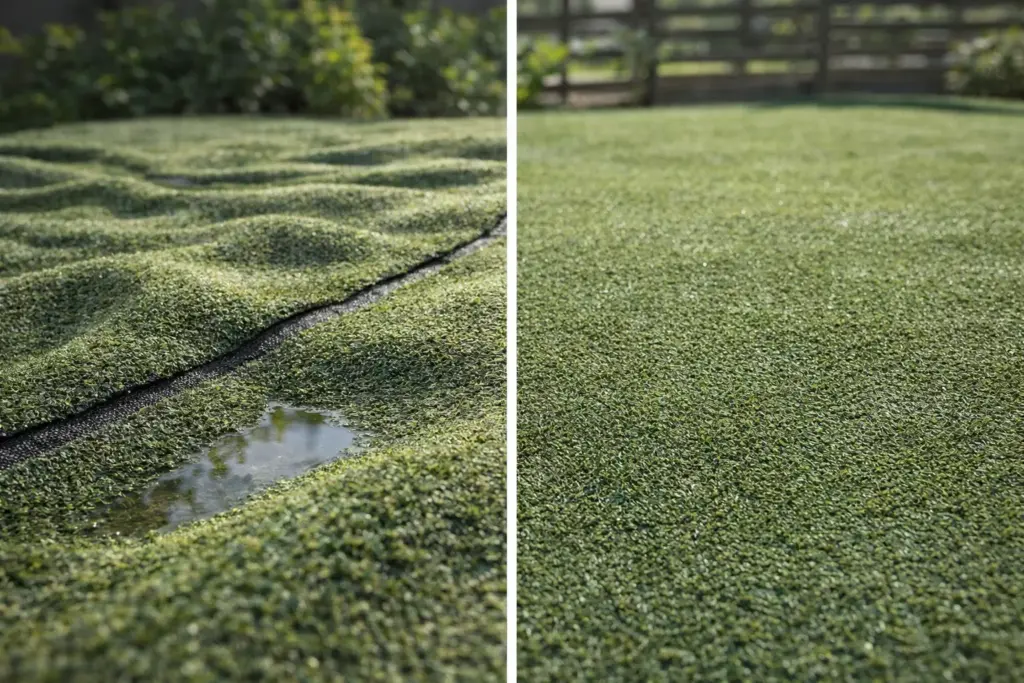
Artificial turf is engineered to deliver consistent performance, durability, and visual appeal over many years. However, its success depends entirely on the quality of the installation. When proper construction methods are not followed, the system can develop issues that are often misattributed to the turf itself. In reality, these outcomes are well understood within the industry and are directly linked to installation errors. This article outlines the most common mistakes, explains why they occur, and provides guidance on how to prevent them.
Common Issues Resulting from Installation Errors
Homeowners frequently report concerns such as uneven surfaces, standing water, visible seams, premature wear, or areas where the turf appears to shift or wrinkle. While these issues may appear to be product-related, they are almost always due to deficiencies in the installation process. Artificial turf operates as a system, and when one component fails, the entire surface reflects that failure.
Root Causes of Installation Failure
Improper Base Preparation
The base layer is the structural foundation of any artificial turf system. If it is not properly excavated, constructed, and compacted, the surface will not remain stable over time. Insufficient excavation depth limits the system’s ability to distribute loads, while poor compaction allows the base to settle unevenly. In addition, improper grading can create low points where water accumulates.
Artificial turf conforms exactly to the surface beneath it. As a result, any irregularities in the base will inevitably appear on the finished surface.
Inadequate Drainage Design
Although artificial turf is permeable, it relies on the underlying base and subgrade to effectively manage water. When drainage is not properly addressed, water cannot move efficiently through the system.
This often occurs when installations lack sufficient slope or when the underlying soil, particularly clay, restricts water infiltration. Without a properly designed aggregate base, water becomes trapped within the system, leading to pooling, odour development, and long-term structural degradation.
Incorrect or Delayed Infill Application
Infill is a critical structural component of artificial turf systems. It provides support to the fibers, helps regulate surface temperature, and protects the turf from mechanical stress.
When infill is not installed immediately, the turf fibers are left unsupported, particularly in high-temperature conditions. Exposure to heat can cause the fibers to expand and soften. If traffic is introduced during this state, the fibers can deform or break prematurely. This behavior is comparable to bending a softened plastic material under pressure.
Over time, insufficient or poorly distributed infill accelerates wear and reduces the turf’s overall lifespan.
Deficient Seaming Techniques
Seaming requires precision and adherence to proper installation methods. When seams are not executed correctly, they become one of the most visible and problematic aspects of a turf installation.
Common issues arise from misaligned grain direction, inadequate adhesive application, or insufficient curing time. These errors can result in seams that separate under stress or become visually apparent over time.
It is important to note that seam failure is not related to the turf material itself but rather to the installation method.
Failure to Account for Environmental Conditions
Every installation environment presents unique challenges that must be considered during the design phase. Factors such as heat exposure, traffic patterns, and intended use play a significant role in long-term performance.
In high-temperature areas, the absence of cooling strategies, such as appropriate infill selection, can lead to excessive surface heat and accelerated wear. Similarly, high-traffic zones without designated pathways will experience concentrated stress, resulting in premature fiber breakdown.
When these environmental factors are not addressed, the turf is subjected to conditions it was not designed to withstand without adaptation.
Preventative Considerations
Preventing these issues begins with a disciplined and methodical installation approach. A properly constructed base, designed with adequate depth, appropriate materials, and thorough compaction, provides the stability required for long-term performance. Drainage must be addressed at both the surface and subgrade levels to ensure that water can move freely through the system.
Infill should be applied immediately after installation and selected based on the site’s specific environmental conditions. Seaming must be carried out with precision, using proven materials and allowing adequate curing time before use. Finally, the installation design should reflect how the space will be used, incorporating features such as walkways or cooling strategies where necessary.
Case Insight
In one residential project, turf was installed during extreme heat but left without infill for several days. During this time, surface temperatures increased significantly, causing the fibers to soften. Once foot traffic was introduced, the unsupported fibers began to degrade, resulting in visible wear patterns.
This outcome was not due to a defect in the turf but rather a lapse in installation protocol during a critical stage of the process.
Final Consideration
Artificial turf is not a standalone product; it is a system that depends entirely on proper installation and environmental alignment. When installed correctly, it performs reliably and maintains its appearance over time. When installation standards are not met, issues will arise, and those issues are both predictable and preventable.
Understanding the role of installation in turf performance is essential for setting accurate expectations and ensuring long-term satisfaction.