
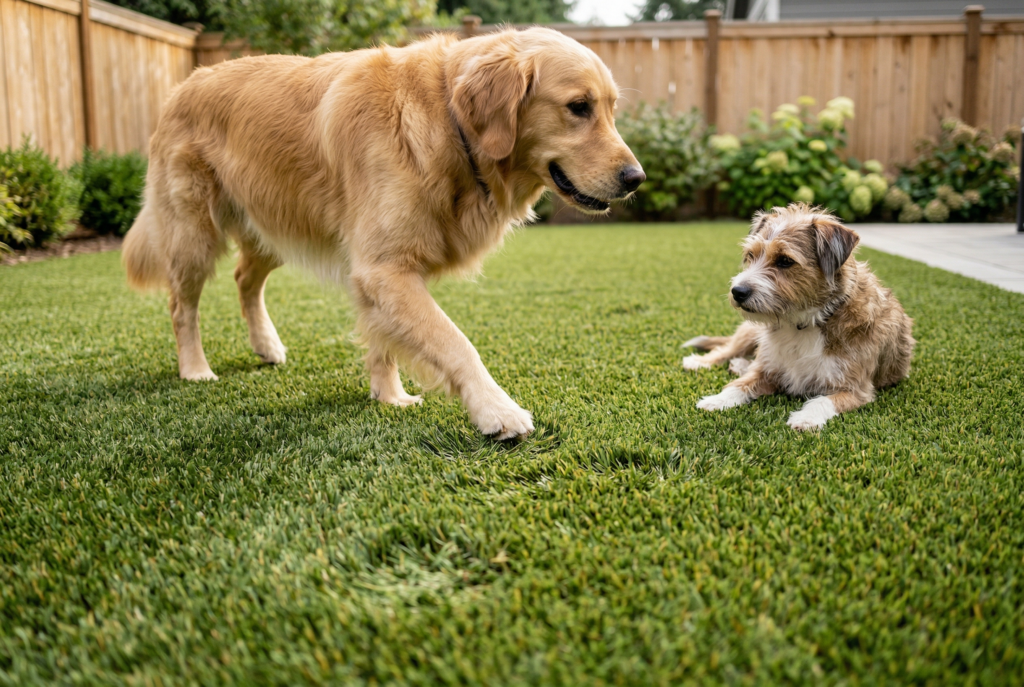
Artificial turf is a popular choice for dog owners due to its durability and clean appearance. However, one of the most common concerns homeowners raise is odor. When smells develop, it is often assumed that the turf itself is the problem. In reality, odor issues are not caused by the turf product but by environmental conditions, system design, and maintenance practices.
This article explains why odors occur, what causes them, and how to prevent them with proper planning and care.
Why Artificial Turf Itself Does Not Smell
Artificial turf is made from non-organic materials such as polyethylene and polypropylene. These materials do not absorb moisture or produce odor on their own.
Odor develops when external elements interact with the system, most commonly:
- Pet urine accumulating in the system
- Poor drainage is preventing proper flushing
- Bacteria grow in trapped organic matter
According to the Synthetic Turf Council, well-designed turf systems are permeable and intended to drain efficiently, preventing the buildup of contaminants.
If odor is present, it is a system issue, not a material defect.
What Actually Causes Odor in Pet Turf
1. Urine Buildup Without Proper Drainage
Dog urine contains ammonia, which produces odor when it concentrates. In a properly installed system, urine should pass through the turf, into the base, and disperse.
Problems occur when:
- The base layer is compacted incorrectly
- There is no drainage layer or exit path
- The subsoil does not absorb or move moisture
When liquid cannot move freely, odor compounds remain trapped and intensify over time.
The University of California Agriculture & Natural Resources explains that ammonia odors increase when urine is not diluted or properly flushed.
2. Incorrect or Missing Infill
Infill plays a critical role in pet turf systems. Standard silica sand does not control odor effectively.
Zeolite infill is specifically designed for pet environments because it can absorb and neutralize ammonia through ion exchange.
Without proper infill:
- Odor remains on the surface
- Bacteria can grow more easily
- Heat can intensify smell release
Research published by the US Environmental Protection Agency (EPA) confirms that zeolite materials are effective at reducing ammonia emissions.
3. Lack of Routine Maintenance
Even with proper installation, maintenance is required.
Odor develops when:
- Urine is not rinsed regularly
- Solid waste is not removed promptly
- Organic debris accumulates in the turf
The American Kennel Club (AKC) recommends routine cleaning of pet surfaces to prevent odor and bacterial buildup.
4. High Heat Conditions
Heat amplifies odor. When turf surfaces heat up, any existing ammonia compounds release stronger odours.
This is especially noticeable in:
- Direct sunlight exposure
- Poor airflow areas
- Dark-colored infill systems
Heat does not create odor, but it accelerates and intensifies it.
Real-World Case Example
A residential pet turf installation experienced a strong odor within the first summer. The homeowner believed the turf product was defective.
Upon inspection:
- No odor-control infill was used
- The base layer was compacted too tightly, limiting drainage
- The area received full sun exposure with minimal rinsing
After correcting the system by adding zeolite infill and improving drainage flow, the odor issue was resolved.
This confirmed that the problem was environmental and installation-related, not the turf itself.
How to Prevent Odor in Pet Turf Systems
Proper planning and maintenance eliminate nearly all odor issues.
Key Prevention Steps
- Install a fully permeable base with proper drainage pathways
- Use zeolite or antimicrobial infill designed for pet use
- Rinse high-use areas regularly to dilute urine
- Remove solid waste immediately
- Design for airflow and avoid enclosed heat traps
When these steps are followed, artificial turf remains odor-free even in heavy pet-use environments.
Final Takeaway
Artificial turf does not inherently smell, even with dogs. Odor issues are the result of how the system is built, how it drains, and how it is maintained.
With proper design, correct infill, and consistent care, pet turf performs cleanly and reliably. When odor occurs, it should be understood as a correctable condition, not a product failure.
This is a known and preventable situation, not a defect in the turf itself.