
Artificial turf heat deserves a straight answer.
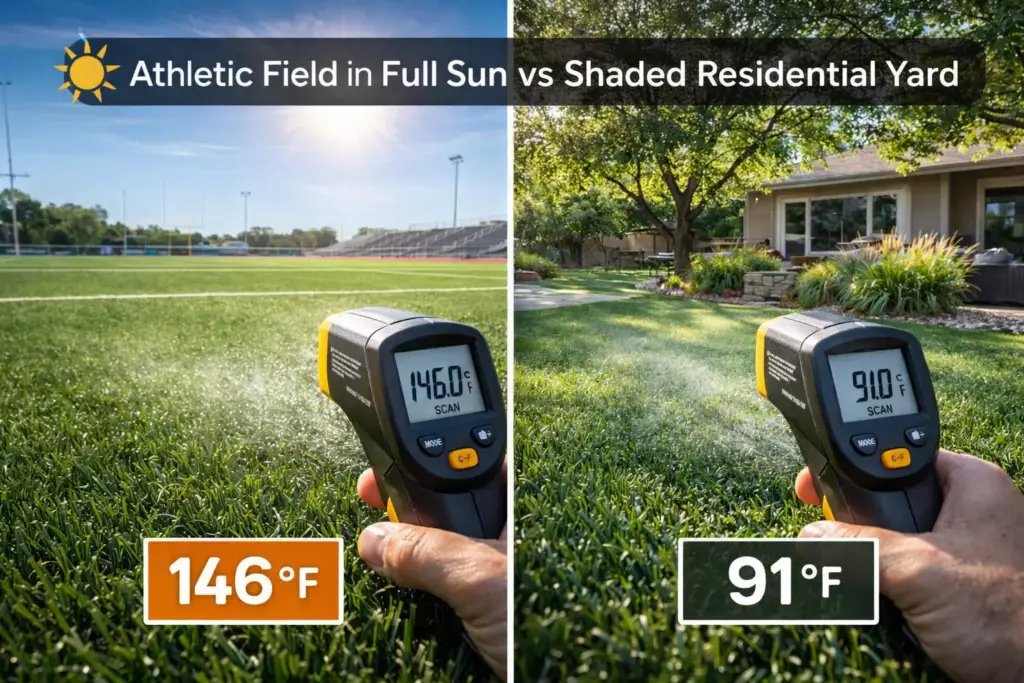
Put artificial turf and living grass in direct summer sun, and the artificial surface can get hotter. Sometimes considerably hotter. That is not a reason for panic, and it is not something homeowners should brush aside.
The useful question is what makes the surface hot, how conditions change it, and what you can do about it.
Fortunately, researchers have spent time measuring this. Quite a lot of time, actually. Scientists do enjoy pointing thermometers at things.
Here is what the research tells us, and what it means for a backyard in BC.
Artificial Turf Heat Is Higher in Direct Sun
Living grass and artificial turf handle solar energy differently.
Grass contains water and cools partly through evapotranspiration. Artificial turf does not have that biological cooling mechanism. Its fibres and other components absorb solar energy, so the surface can become much warmer under strong direct sunlight.
The New York State Department of Health reports measurements in which synthetic turf surfaces were substantially hotter than the surrounding air. It also notes that the highest surface temperatures generally occur in direct sunlight and that temperatures can drop quickly with cloud cover. New York State Department of Health
Research summarized by Penn State’s Center for Sports Surface Research reaches the same basic finding: synthetic turf surfaces exposed to sunlight can reach significantly higher temperatures than natural turfgrass. Department of Plant Science
Older field measurements from Brigham Young University also compared synthetic and natural turf and recorded substantially higher temperatures on the synthetic surfaces. Strikesol
Three different sources. Same practical message.
Artificial turf gets hot in direct sun.
Why the Surface Temperature Can Change So Quickly
A turf temperature reading is a snapshot, not a personality test.
Sun intensity matters. So does shade. Cloud cover matters. Surface materials matter. Colour can matter. The conditions at 11 a.m. may not resemble those at 2 p.m.
Penn State’s research shows just how responsive synthetic turf can be to changing conditions. Its work has examined variables including fibre and infill combinations, irrigation and exposure to sunlight. Department of Plant Science
That helps explain why there is no single useful answer to, “How hot does artificial turf get?”
The better answer is: it depends on the conditions at that moment.
This is particularly important for families. A day that feels pleasant in the shade can still leave a sun-exposed surface uncomfortable for bare feet or paws.
Treat the surface as its own little weather system. Check it before use rather than relying only on the air temperature.
What Rinsing Artificial Turf Actually Does
Water can cool a hot turf surface.
It just may not keep it cool for long.
The NYSDOH cites BYU research in which watering produced a large initial drop in synthetic turf surface temperature, followed by a rapid rise after watering stopped. Penn State has also studied irrigation and found that cooling effectiveness varies with conditions. New York State Department of Health
For a homeowner, the lesson is simple.
A rinse can provide temporary cooling before people or pets use the yard. Do not assume that one rinse means the turf will remain comfortable for the afternoon. Check the surface again as conditions change.
Shade is useful for the same obvious reason umbrellas have enjoyed a long and successful career. Less direct solar exposure means less solar energy reaching the surface.
Trees, umbrellas, pergolas and other appropriate shade features can all be considered when planning a yard.
Colour and Placement Deserve Attention
Artificial turf is green, but green is not one colour.
Penn State has specifically studied colour and synthetic turf surface temperature. Its testing found differences among materials and configurations, although changing colour alone did not eliminate the heat issue. Department of Plant Science
For a residential project, this means heat should be part of the planning conversation rather than something considered after the yard is finished.
Look at where the strongest afternoon sun falls. Think about where children tend to sit and where a dog likes to stretch out. Consider where shade already exists and where it could be added.
Lighter turf colour options may also be worth comparing as part of the overall design. Colour is one factor, not a magic thermostat.
Placement can matter even more when there is a large expanse of reflective glass nearby.
Artificial Turf Heat and Reflected Window Sunlight
This is where an ordinary sunny yard can develop a very concentrated problem.
Sunlight can reflect from certain windows and focus energy onto a relatively small area. Depending on the glass, its shape and the angle of the sun, that reflection can produce an intense moving hot spot.
The result can be distorted, shrivelled or melted turf fibres.
The clue is often the pattern. Instead of a whole sunny area simply feeling warm, damage may appear in a narrow strip or concentrated patch that corresponds with a reflection at a particular time of day.
If turf will sit near large or highly reflective windows, inspect the area while planning the project. Watch where reflections travel during strong sun. Remember that the angle changes through the day and through the seasons.
Possible ways to address a problematic reflection include suitable exterior window films or screens, awnings, shade structures and carefully placed plants. Ask a qualified window professional which treatment is appropriate for the specific glazing before applying film or making changes to a window.
PGB’s warranty terms matter here too. The PGB Limited 15-Year Product Warranty is pro-rated, and direct or reflected heat over 65°C is excluded from coverage. 02 PGB Writer Reference (upload…
A Practical Hot-Day Routine
You do not need a backyard laboratory. You need a few sensible habits.
On sunny days, check the turf surface before children or pets use it. If it feels too hot for comfortable contact, wait for conditions to change, add shade or rinse the surface and check it again before use. Supervise children and pets on hot days.
For new projects, consider sun exposure before deciding where turf, seating and play areas will go. Existing shade is valuable. Planned shade can be even better because you can put it where people actually spend time.
If choosing between suitable turf products, ask about available colours and think about the amount of direct sunlight the area receives.
And look at the windows.
That last one sounds strangely specific until you see a bright reflection travelling across a lawn like a tiny spotlight with ambitions.
Artificial Turf Heat Is a Planning Issue
Research gives homeowners a useful starting point: artificial turf can become significantly hotter than living grass in direct sunlight. New York State Department of Health
From there, good decisions are pleasantly ordinary.
Plan shade. Consider colour and placement. Rinse when temporary cooling would help. Check the surface before children and pets play. Identify strong window reflections before they become a problem.
Heat is part of owning an outdoor surface exposed to summer sun. Understanding how that surface behaves makes it much easier to plan around.
To compare turf colours and feel the different products in person, visit the Premium Grass Blades showroom in Maple Ridge. PGB supplies artificial turf and related products and can help you think through the conditions around your project. 02 PGB Writer Reference (upload…
FAQ
Does artificial turf get hotter than real grass?
Yes. Research from NYSDOH, Penn State and BYU has documented higher surface temperatures on synthetic turf than natural grass under direct sunlight. The actual temperature varies with sunlight and other conditions. New York State Department of Health
Can I cool artificial turf with water?
Rinsing can lower the surface temperature temporarily. Research shows that the temperature can rise again fairly quickly, so check the surface before use rather than assuming it has stayed cool. New York State Department of Health
What should I do before children or pets use turf on a hot day?
Provide shade where practical, supervise children and pets, and check the surface temperature before use. A rinse may provide temporary cooling. PGB’s approved guidance specifically recommends shade, rinsing on hot days and checking the surface before use. 02 PGB Writer Reference (upload…
Can reflected sunlight from a window damage artificial turf?
Yes. Concentrated reflected sunlight can create intense localized heat and damage synthetic turf fibres. Check reflective windows during project planning and speak with a qualified window professional about suitable ways to reduce a problematic reflection.