Artificial Grass for Strata: What Councils Should Consider
Artificial grass for strata properties is a practical decision, not a decorating decision.
The grass has to look good. Of course.
But a strata council also has to think about upkeep, common-area consistency, drainage, contractors, warranty terms and the budget. Those details matter more than a nice sample sitting on a boardroom table.
Artificial turf can make sense for shared outdoor areas where natural grass creates recurring work. It does not remove every maintenance task. It changes the work.
That distinction matters.
Why Artificial Grass for Strata Gets Considered
Natural grass comes with a familiar list of jobs.
Mowing. Watering. Fertilizing. Repairing worn areas. Dealing with mud. Trying to keep several patches of lawn looking roughly like they belong to the same property.
Artificial turf does not need watering, mowing or fertilizer.
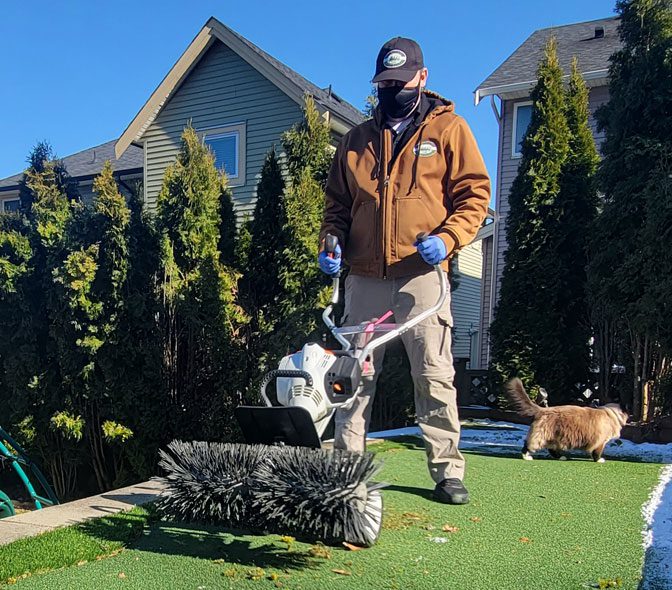
It still needs care. Leaves and other debris need to be removed. Fibres may need brushing in busy areas. Pet areas can require rinsing and cleaning. Infill should be checked as part of regular maintenance.
For a strata, that can mean fewer recurring lawn-care tasks without pretending the outdoor space takes care of itself.
That is usually a more useful way to evaluate turf.
Do not ask, “Does this require maintenance?”
Everything outside requires maintenance.
Ask, “What work will this require, how often will we need to do it, and who will be responsible?”
A Consistent Look Across Common Areas
Shared property creates a simple problem.
One patch gets more shade. Another gets more foot traffic. One area gets used by dogs. Another sits beside a walkway. Natural lawn conditions can vary considerably across the same complex.
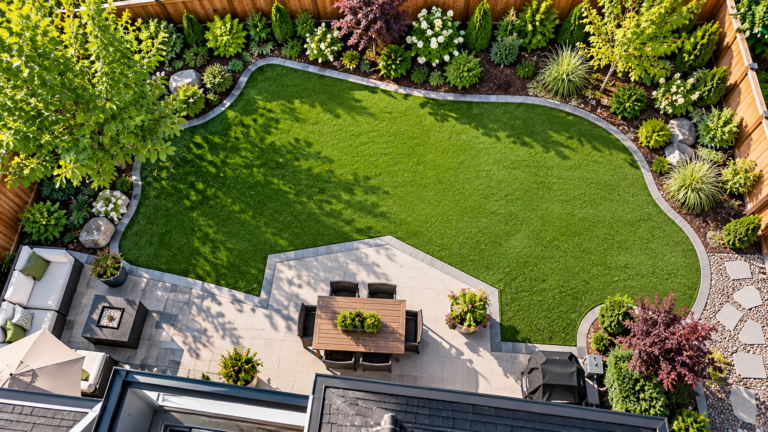
Artificial turf gives a strata another way to create a more consistent appearance across selected common areas.
That does not mean every square metre needs turf.
It may make more sense around entrances, shared lawns, pathways or other spaces where natural grass is difficult to keep looking consistent. The right layout depends on drainage, use, access and the design of the property.
Before selecting a product, think about how each area is actually used.
A quiet decorative strip and a heavily travelled common lawn do different jobs. They should not automatically get the same specification simply because they share an address.
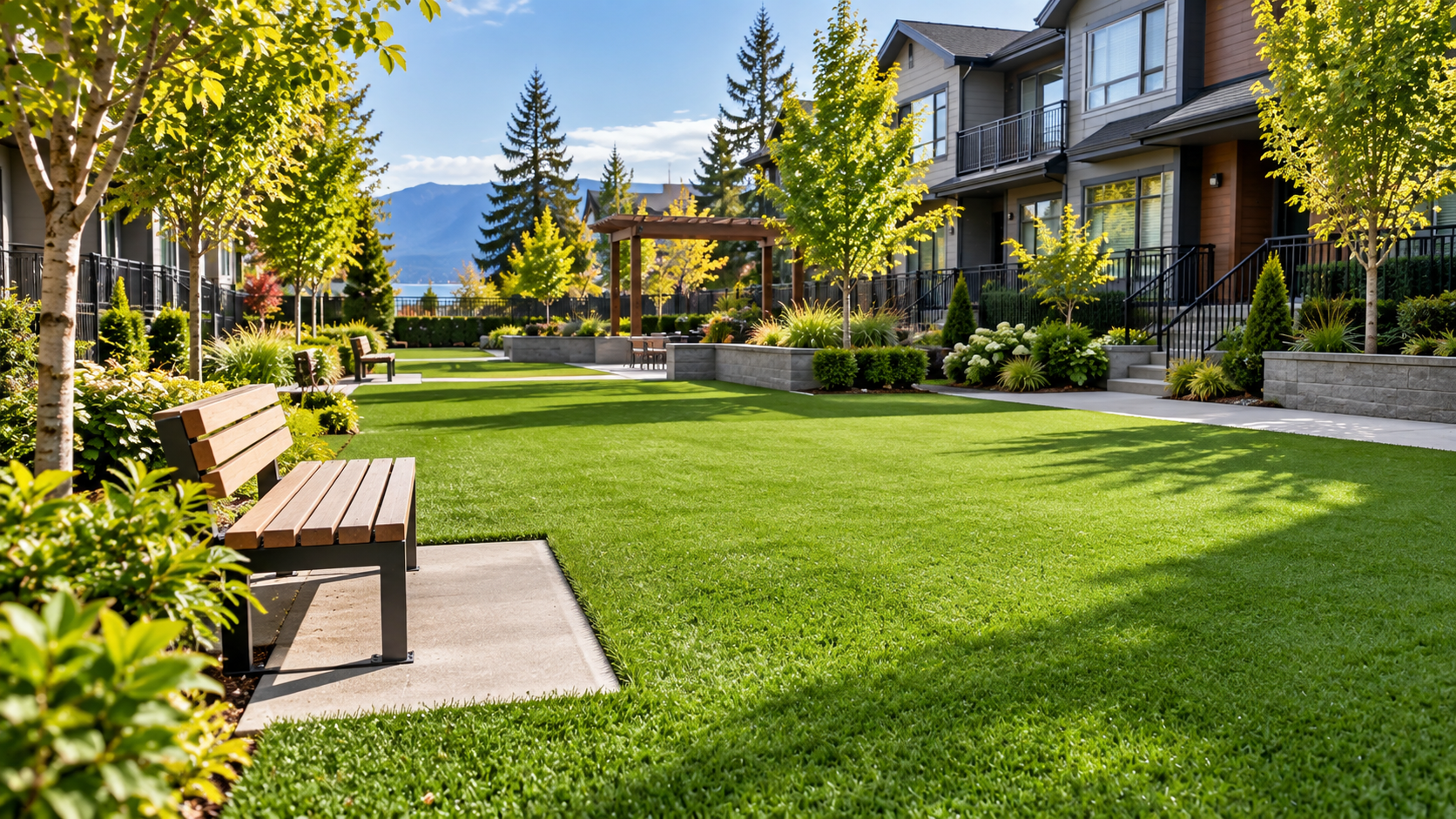
Strata councils can review PGB’s information on artificial turf for stratas and townhome complexes when planning common areas.
Watering Restrictions Change the Equation
Summer lawn care in BC can get complicated when watering restrictions are in effect.
Artificial turf does not need watering to stay green.
That is straightforward.
It may still be rinsed when cleaning is needed, particularly in pet areas, subject to current local rules. Strata councils should check current watering restrictions with their municipality or the appropriate regional authority rather than relying on last year’s rules.
This can simplify one part of common-area planning.
There is no lawn-watering schedule to manage for the turf itself. No deciding which volunteer remembered. No wondering why one section looks different from another because irrigation coverage varies.
The strata still needs a maintenance plan.
It is simply a different one.
Get the Warranty in Writing
A strata purchase is not the place for vague promises.
Ask for the written product warranty before approving the order. Read what it covers. Read what it excludes. Keep a copy with the property’s records.
PGB’s landscape turf is backed by the PGB Limited 15-Year Product Warranty. It is pro-rated and subject to its terms and exclusions. Turf used for putting greens has different warranty terms.
Installation matters here too.
Work that does not follow PGB guidelines, including turf that is not infilled to the advised amount, may not be covered under the warranty. Direct or reflected heat over 65°C is also excluded.
That last point deserves attention around buildings.
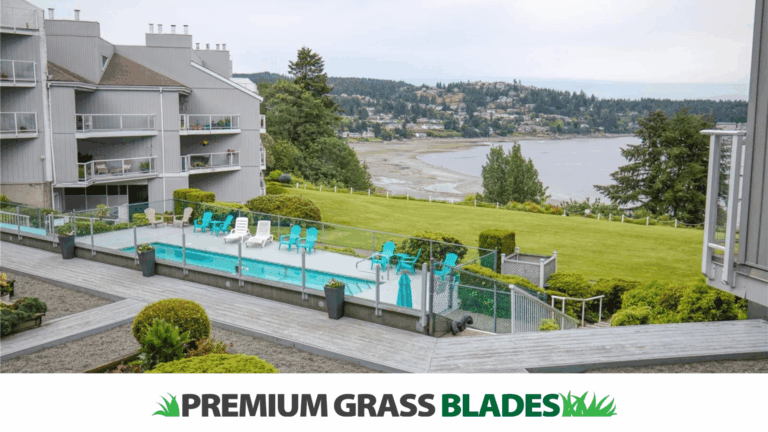
Sunlight reflected from windows can concentrate heat onto synthetic turf. If turf is being planned near windows, the site should be assessed for potential reflected-heat exposure before work begins.
Paperwork is boring.
Boring is useful when a strata is spending shared money.
Bigger Projects Need Better Measuring
Strata projects can cover larger areas than a typical residential yard.
That makes measuring important.
Larger orders may reduce the material price per square foot, but ordering more material is not automatically the same thing as spending less overall. Layout, roll planning, seams, waste, access, base preparation and labour all affect the project budget.
Get the area measured carefully.
Then get the material requirements worked out before treating a price-per-square-foot figure as the project cost.
A slightly cheaper material order does not help much if poor planning creates unnecessary waste.
For councils comparing proposals, make sure the quotes are actually comparable. One quote may include different base work, disposal, access requirements or site preparation than another.
Compare scope, not just the number at the bottom.
Keep Turf Supply and Labour Clear
This part should be simple.
Premium Grass Blades supplies artificial turf and related products. PGB does not provide turf installation. PGB can refer customers to independent installers, and those installers contract with customers directly.
That means an independent installer should quote the labour and installation work directly to the strata.
Keep those responsibilities clear from the start.
The supplier can help with turf and product questions.
The independent installer can assess the site, determine the work required and provide the installation quote.
For a strata council, clear roles make proposals easier to review. You know who is supplying the product and who is responsible for the installation work.
It also makes questions easier to direct to the right person.
Approve the Project Before Ordering
Strata projects involve more than choosing a turf sample.
Before ordering, confirm whatever approvals are required for your property. Check your strata’s own rules and processes. If municipal requirements may apply, check with the municipality as well.
Then look at the physical site.
Where does water go?
How will existing drainage be handled?
Are there windows that could reflect concentrated sunlight onto the turf?
How heavily will each area be used?
Will pets regularly use the space?
How will maintenance crews reach it?
Who will handle brushing, debris removal and cleaning after the project is finished?
These are ordinary questions.
They are also the questions that prevent expensive assumptions.
FAQ About Artificial Grass for Strata
Does artificial turf eliminate strata landscape maintenance?
No. It removes lawn tasks such as mowing and does not need watering or fertilizer, but routine care is still required. That can include debris removal, occasional brushing, rinsing and attention to pet areas.
Can a strata use the same turf everywhere?
It may be possible, but product selection should reflect how different spaces are used. Foot traffic, pets, drainage and the purpose of each area should be considered before choosing turf.
Who handles the installation?
PGB supplies turf and related products. An independent installer quotes and contracts for installation directly with the customer. PGB can provide a referral to an independent installer.
Can a larger strata order reduce material costs?
Larger orders can lower the price per square foot. The final project cost still depends on the product, quantity, site conditions, layout and the independent installer’s labour quote.
Artificial grass for strata works best when the decision is treated like any other common-property project: define the problem, compare the real costs, understand the maintenance requirements and put responsibilities in writing.
For councils starting that process, call 604-757-2899 to talk through your strata project.